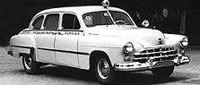
Cadillacs rode like you were on a cloud, they "never hit a bump".

Really until the mid 1970's you would have heard horrorific stories from Ambulance attendants. They didn't have access to equipment and training until Pre-hospital medicine evolved after the Vietnam Conflict. You can thank the Medics and Corpsmen in WWII, Korea and Vietnam for modern prehospital care. They invented, or gave ideas for nearly everything we have now. Including Paramedics; and advanced life support.
I've heard stories from attendants, and my grandfather; relating to first aid care in our rural area. What EMT's and Paramedics who are new to EMS must learn is that there is a difference between Urban and Rural EMS; even today with so many advances. Not just distances between patients and difinitive care facilities, but between services and patients. It is not always possible to pay services to cover these areas. Some services only have 10 calls a year; some have thousands. Either way, it's better now that it was in the days of the caddy.
I slept for about three hours, and now I can't get back to sleep; so I guess I have time to share some of what I've heard over the years...
My grandfather told me of when he worked for a creamery in town; at the time he lived in a house next to one of the two funeral parlors in town. There were two ambulances; one just a hearse with trasnport capabilities. The other a hearse with a first aid kit. The one near my grandfather had people from the community as traffic directors, funeral drivers, stand in's, etc. My grandfather drove the hearse on emergency ambulance runs. He said it had to be a multi-funcitional vehicle. It was used as an ambulance, but it was still a hearse. The first aid cabinet fit into the front against the seat; and between two attendant seats. The oxygen resuscitator sat on the floor in front of that; and the cot mounts were permanent.
The carried one Resuscitator w/ Mask and two copper oxygen tanks (This belonged to the fire company, who used it for drownings and smoke inhalation). The ambulance used it as a oxygen tent, assisting doctors all over a three-county radius. The first aid kit was simple; basic bandaging supplies; about 100 cravats (Triangular Bandages); wooden splints; a Thomas Splint; a Spine Board; a cot; and three military stretchers. You could fit five people laying down in the ambulance. One on the cot, two on the floor side by side; and two on the ceiling. Now this was the Load & Go days; so you didn't have to keep track of vitals; etc. Just getting them to a hospital was enough. Often the funeral homes would rely on each other to get multiple patients to the hospital. A doctor could ride w/ the more serious patients providing pain relief or fluids. IV's were often a luxuary too; but after the national standards for EMT's came around in the early 1970's; the local EMT's were trained to provide IV's. Paramedics were not available until 1992. The funeral homes gave up service in 1967 and the Fire Co. took over. They were able to provide IV's on the Basic EMT level until 1995; when ALS became more readily available.
In the 1950's the hearse was black w/ two red lights on the front near the hood. Sort of like elevated turn signals that flashed at the same time. In the 1960's the hearse was white and had a single red "bubble" light on the roof, and a federal siren mounted under the hood and behind the grille.
I've been told that at one point they hauled upto nine patients in one cadillac ambulance b/c in the mid 60's only one ambulance service operated after a closure. This was the only ambulance available to about 15,000 residents in three rural and wilderness counties.
Like I said, the caddy rode like a dream. I've rode in a cadillac hearse before-to get the feel. It was exactly like an ambulance. Had a cot for removal; and seats; ceiling hooks. But no first aid cabinets. It was perfect, not too cramped; and it was explained to me by the funeral director how they would fit nine patients in it, if that was legal. You'd be suprised. I can't put into words what its like; but I tried my best. Maybe a bit cramped; but you worked with what you had. And they made it work, I thought it was just enough room to be comfortable. Maybe in some low-tops it would be a bit uncomfortable; but the high tops were just a bit more short than the current Econolines. Not enough room to stand up, but it must have worked b/c people are so fond of them.
The bay shore people use the caddy's for LDT's Long Distance Transports or Red Blanket Transports. This is b/c the caddy offers a supreme ride in comfort on long trips. Plus it makes people feel a bit more comfortable...
I was once told that you should ask a patient if they are comfortable twice. Once when you load; and once before you arrive. Because that in itself is a necessary measure to prehospital care. Comfort.